



I entered a short position on TBT this morning. For one thing, I think interest rates are going to head lower, which will depress this security, and second, these "ultra" ETFs are inclined to degrade anyway. My stop is at 37.33
Slope of Hope Blog Posts
Slope initially began as a blog, so this is where most of the website’s content resides. Here we have tens of thousands of posts dating back over a decade. These are listed in reverse chronological order. Click on any category icon below to see posts tagged with that particular subject, or click on a word in the category cloud on the right side of the screen for more specific choices.
Vix and Yen break up (by Springheel Jack)
We've reached the stage where I'm starting to look for a decent classical low on SPX. What we need for that is a bounce and then a lower low on SPX with positive divergence on daily RSI, or on NYMO as Cobra was illustrating with this excellent chart last night. No sign of that so far on the SPX chart, and I'm still leaning towards a target low in the 1220 – 1230 area.
There's some concern that this may not be a correction of course, but I have two lines in the sand for that. The first is a close below 1209 SPX, as that would be more than a 10% move from the high, and I've read that there haven't been two corrections of over 10% on SPX in a single cyclical bull market since 1945, the first move down over 10% having been seen last summer of course. The second would be a break with conviction below 1175 SPX, as that would break the main bull market rising channel that I've marked on the SPX daily chart. I'm not expecting to see either here though and I'm seeing this as just a correction unless demonstrated otherwise:

Vix broke up from my trendlines yesterday so I'll have to retire my 30min chart for the time being. I'm actively on the watch for a Vix buy signal when we see Vix pull back within the daily BBs:

Copper is still looking divergently bullish and is testing the short term resistance trendline in the 428 area. If it breaks up I'll be expecting a move to a potential IHS neckline at 438:

30yr Treasury yields moved down sharply in line with my expectations yesterday. I'm seeing 4.25 as the key support trendline for this and a break below that would indicate that we are seeing more than a correction:

I was going to post the long term USDJPY chart today arguing the technical case for a long (short Yen) at the 78.75 level. Overnight though there were wild moves in Yen that pushed USDJPY as low as 76.42, so this chart is now just a good example of a long term support trendline breaking:

Another long term support trendline is being retested today, and that is the support trendline for USD from 2008, after what has been the most listless flight to safety bounce in recent years. There's a case for a long on USD here but I won't be taking it:

I'm leaning towards more upside today as the timing feels right and ES and NQ made decent lows yesterday with positive RSI divergence on the hourly charts. I think that the obvious targets are 2254 on NQ and 1283 on ES. I'm not feeling well today so I'll miss most of the session I think. Everyone have a good day. 🙂
JSTFR Still I Think (by Springheel Jack)
There was another strong bounce yesterday and many have called the bottom again here, which has been the case every time there has been a bounce since this correction started. There are no strong indications that the bottom has been made yet though, and I'm leaning towards seeing more downside on balance, though I think the bulk of the correction is behind us now, if this is just a correction which seems likely. I've had a close look at the SPX daily chart since this cyclical bull started in March 2009, and apart from the low in July 2009 every significant bottom has been signalled with positive divergence on the daily RSI, which we're not seeing yet. The big lows in July 2009, and in Feb, July and November 2010 were all also at very significant support levels, and while 1255 is a significant level, the obvious target is at the 1220-1230 level, and that has not yet been reached. Here's the SPX daily chart for the bull market so far:

Vix is looking interesting. I called the target for Vix a bit high yesterday, as it was a little hard to pin down on the chart, but Vix rose exactly to my upper resistance trendline and reversed there:

On the daily chart Vix moved above the daily BBs for the second time in this correction and that does look significant, as Vix may now be setting up to give a buy signal. These have a reasonable track record at preceding significant bounces, and I'll be watching to see whether this develops into a Vix buy signal:

With both Yen and USD looking seriously unwell, the remaining flight to safety trade still running is to treasuries, and I posted the IHS on 30yr treasuries yesterday. Here's the inverse of that on the yields chart and you can see where I'm thinking yields are headed here. We're still some way from the obvious target and that is supporting the case for more equities downside here:

EURUSD is continuing to struggle at 1.40, but I'm not seeing much to suggest that USD will do more than trade sideways during this correction. Unless EURUSD can break current rising channel support, now in the 1.382 area, then I'm expecting EURUSD to continue moving up after the equities correction is finished:

Copper is looking divergently strong here, and is now retesting the broken H&S neckline in the 425 area. Copper's been acting as a decent lead indicator recently, and a break up with conviction would boost the bull case considerably:

Oil is stabilising as pro-democracy unrest in the Middle East is being suppressed. I'm expecting a bounce back to retest 100 and an H&S may be forming that may then take oil back into the 80s. A break back up through 100 would suggest a retest of the recent highs:
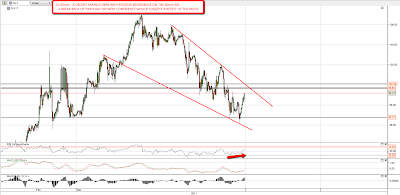
I'm still of the view that this is just a correction and I'm looking for a decently signalled low here, though that doesn't always happen. There are some signs that the correction is drawing to a close, but not enough to think that it is over yet. I'm still leaning bearish but would be concerned if ES breaks back up over 1285 with conviction. I'm also watching the 425 level on copper as a possible directional indicator.
Juggling Angry Badgers (by Springheel Jack)
People often forget that officials lie as a matter of course, and that open government is, in consequence, always something of a joke. One of my favorite quotes is from a film or documentary about Watergate where an official was answering questions from a politician trying to establish who first suggested that there should be a cover-up. The official replied that 'no-one ever suggested that there might not be a cover-up', and I expect that was exactly right. Yesterday there were two stories coming out of Japan about the potential nuclear accident there. The official version was that everything was well under control, and the second was from outside experts saying that flooding reactors with seawater was a last ditch desperation measure that was most unlikely to succeed. No prizes this morning for guessing which assessment was correct.
That's worth remembering when we hear soothing statements from central bankers about the desirability of obviously reckless money printing and debt accumulation, or when they make statements about inflation remaining subdued against a backdrop of obviously accelerating price inflation. We should always remember the image of Comical Ali (Mohammed Saeed al-Sahaf), the hapless Iraqi Information Minister, making statements about the US forces being crushed in the late stages of the invasion of Iraq, with US tanks rolling into Baghdad clearly visible behind him as he spoke. All of these officials see managing expectations and soothing fears as their job, none of them seek to disseminate the truth. Comical Ali was perfectly representative of officials making statements to the press, and it has always been so. Doubtless one of Nero's officials was dismissing reports of Rome burning as scaremongering as Nero fiddled and Rome burned behind him. As a breed they would have to work hard on improving their reputation for honesty to compete with a four year old child in search of chocolate.
Looking at the markets this morning in the wake of reports that the stricken nuclear reactor in Japan is now releasing large amounts of radiation to atmosphere. I see that the Nikkei is down over 10% overnight, and there have also been heavy falls in other developed equity markets. Some nice technical lows are developing at support, but a friend of mine remarked this morning that he'd rather juggle angry badgers this morning than play the open, and I'm inclined to agree. It wouldn't take a lot to see a flash crash situation develop here and using stops looks particularly important today.
On ES the triangle target at 1252 was made overnight and ES is trying to make a short term low in the 1250 area. That might succeed short term, though I'm still expecting a test of the 1220-30 area before this correction ends:
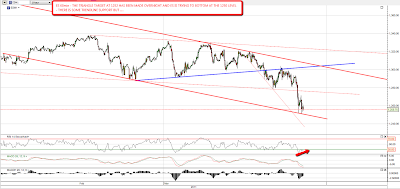
NQ fell through the 2250 support level, and retested it before going lower. That looks ominous and I'm hoping that a broadening wedge I've identified on the NQ chart holds today. The H&S target is 2160 of course, which would fit well with my ES target in the 1220-30 area, so I'm expecting more downside regardless of any bounce here:
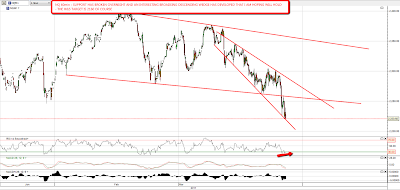
Looking at 30yr treasuries this morning I'm seeing strong signs that there will be more upside. Significant resistance has broken overnight and a very nice IHS has formed over the last few days with a target just under 124:
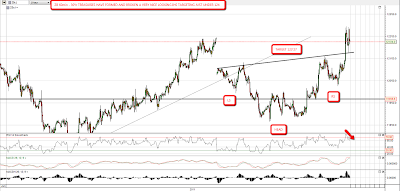
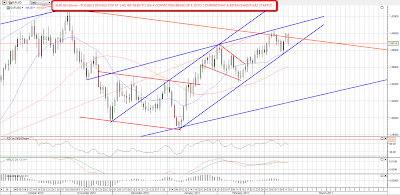
One big question this morning is whether the USD has enough credibility left to assume a traditional role as a flight to safety target with treasuries. Yen would normally be the third flight to safety trade of course, but probably not this time for obvious reasons. Looking at the EURUSD chart there is some sign that EURUSD may have made a double-top at 1.40, but we'll have to see a conviction break of 1.38 to confirm weakness:
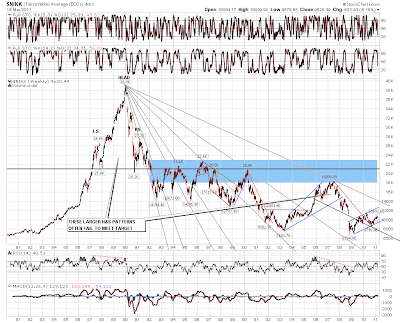
The Nikkei is down over 20% in the last few days and is starting to look interesting. The current rising channel on this long term chart has broken overnight and I'm seeing strong trendline support in the 7700 area:
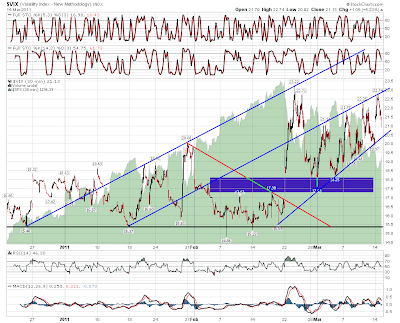
I posted a Vix 30 min chart the other day and the trendlines I drew on it have been holding beautifully. I'll be looking to see whether Vix breaks overhead resistance this morning and if it does I'll be expecting a move to the next resistance trendline in the 27 area:
Overall I'm leaning towards a bounce here in the context of further falls later on, but it wouldn't take a lot to push this over the edge this morning so any longs should be cautious. The Ides of March are not always trouble free, as I'm sure Julius Caesar would agree.
Inflation… It’s What’s For Dinner
The following is excerpted from the March 6th Edition of Notes From the Rabbit Hole:
Inflation… It’s What’s For Dinner
While NFTRH was highlighting risk leading into the initial phase of inflationary blow-ups – and surely Egypt, Libya and other strained global situations are symptomatic of chronic and disenfranchising inflation – it is important to understand that headline events do not move markets, beyond the very short term. Indeed, I saw enough last week to nudge the very short-term risk profile toward neutral; and in an age of inflation onDemand one should question a net bearish stance more often than not. Inflation ran the 2003-2007 bull market quite well until ultimately, the soufflé pancaked in 2008.
Bloomberg’s top two headlines at the end of the week: “China’s Wen Targets Inflation as Top Priority to Cut Risk of Social Unrest” and “US Stocks Rise as Economic Optimism Overshadows Increase in Oil Prices”.
I want to spend some time breaking down these headlines, before transitioning to precious metals analysis, where we will take the macro pulse of the sector and review two core gold explorers, from a technical perspective.
Back on message, inflationary policy is what the asset spectrum feeds upon, as the ‘ruling’ class (including you and me ladies and gentlemen, as asset speculators) benefits to the detriment of the non-investor classes, in the US and the world over. People are suffering due to the cheapening of the money used as the medium of exchange for their wages, even as we go forth and speculate on some high potential gold explorers, uranium prospects, emerging, productive and/or resource rich markets, and other areas that offer opportunity in an inflationary world.
Enter, the first Bloomberg headline above. In the article http://tinyurl.com/nftrh126a, Premier Wen Jiabao states “We cannot allow price rises to affect the normal lives of low-income people” to which I would answer “Mr. Premier, you have already allowed inflation to affect the normal lives of low income (really low income) people, because you have already promoted and feasted upon an epic and ongoing policy of inflation. You now attempt to stuff the genie back in the bottle because you see some frontier markets blowing up due to global inflation dynamics and perhaps wonder how long it will take for the flames to reach your homeland.”
From my vantage point in the downsized productive (i.e. manufacturing) segment of the US economy, I have watched a myopic and collective greed in the United States work in tacit partnership with China to cheapen the entire concept of free trade. The US, manufacturer of the world’s reserve currency, has been able to leverage and monetize its reputation – built of sweat equity in the earlier parts of the previous century (for ref. see my first ever public article from 2004, Frankemarket Lives http://www.biiwii.com/frankenmarket.htm) – in partnership with China, by selling Treasury bonds, printing money and creating a heretofore limitless inflationary drag on the US currency.
Edit: for an unbelievable view of that very different America, see here: http://tinyurl.com/biiwii3811d
China, in pinning its currency to the dollar, and accepting massive volumes of USD denominated instruments in exchange for the work and productivity of its people, has inflated right along with the US. Typical of politicians, the Politburo now tells the people the straight deal after it is too late and presumably upon feeling an implied threat as indicated by the Egypt and Libya uprisings. China’s emerging manufacturing economy has been built by direct, indirect and ongoing inflation.
A robotic talking head sums up the second article http://tinyurl.com/nftrh126b:
“It’s a battle between the negative geopolitical environment versus the very strong economic fundamentals,” said Benjamin Pace, who helps oversee about $420 billion as the New York-based chief investment officer of Deutsche Bank Private Wealth Management. “The economic environment is very equity friendly. The current geopolitical environment and its impact on oil prices, not so much.”
No sir, it is a battle between the geopolitical manifestations of inflation and the seemingly strong economic fundamentals produced by said inflation as grains, clothing materials and energy costs rise right along with precious metals in a not so tacit indictment of these “strong economic fundamentals” that you speak of. During the 2003-2007 cycle, the same thing happened as a result of policy makers’ refusal to allow the economy to purge itself through a hard downturn, which would have eventually set the stage for a new and lasting up cycle. No, in and around 2000, the game became inflation onDemand; inflation as economic stimulant; inflation… it’s what’s for dinner.
Short-term, global and especially US markets are back in the game of blaming oil for the market’s ups and downs. This is similar to the ending stages of the 2003-2007 cycle. Be aware that the majority of ‘Hope 09’ (and ‘Full Hubris 10’, ‘Suck-in 11’, AKA the inflationary cyclical bull born 2008, died… ?) has been attended by a positive correlation to oil, copper, food prices… the stuff that people need; which brings us right back to square one of this segment… the effects of inflation are beginning to erode peoples’ lives and it is becoming obvious. The actual inflation has been ongoing up to now.
Going forward, global policy makers will not be able to merrily inflate their way to bull nirvana. See Wen above; see Trichet last week talking about euro rate hikes. See Ben Bernanke… well, our Fed chief has not quite gotten the memo yet. But even in the US, the winds of change appear to be blowing. Whether our congress puts a stop to it or natural market forces do (I’ll take ‘b’ Alex), the inflation cannot go on uninterrupted forever.
And this, my friends, is where investing and/or speculating becomes tricky. This is where the specter of deflation or more accurately, a deflationary ‘event’ comes into play. At the root of this dynamic is the case for the NFTRH ‘gold stocks above all others’ stance, because it is in gold’s ‘real’ price that the gold mining industry finds its most positive fundamentals, with gold outperforming the things of positive economic correlation, including those that feed into gold mining cost structures.
Increases in gold’s ‘real’ price are most pronounced during a collapse of an inflationary construct, as in 2000 and again in 2008. This is usually accompanied by deflationary hysteria and if one is prepared, epic opportunity. Silver’s impulsive increase in relation to gold argues that the construct may not yet be ready to roll over since a positive silver-gold ratio (SGR) indicates that a sea liquidity continues to rise.
On that note, let’s now transition to the precious metals, commodities, etc.

