Slope of Hope Blog Posts

Slope initially began as a blog, so this is where most of the website’s content resides. Here we have tens of thousands of posts dating back over a decade. These are listed in reverse chronological order. Click on any category icon below to see posts tagged with that particular subject, or click on a word in the category cloud on the right side of the screen for more specific choices.

Caveat Tauri (by Molecool)

By -

I know most of you bears have thrown in the towel by now. Well, I myself am not a big fan of fighting windmills Don Quixote style. However, a very bearish trap got triggered last night and when I took a peek inside I hardly could believe what I was seeing.

[shameless plug] This is a repost of what I sent to my own subs last night. They get it first but the magnitude of this event may be huge, thus this should be passed on to any of the few bears who are left, which is why I decided to re-post it here on the Slope.[\shameless plug]

2010-04-05_ISEE
 
Yesterday's equities only ISEE reading closed at a whopping 276. That is only three digits lower than the all time high of 279 painted on October 8th, 2007 – a few days away from the highest tick ever on the S&P 500, which on October 11, 2007 pushed to a record high of 1,576.72 and the very same day closed at 1,554.41. 512 days later the SPX closed at less than half that after having touched the March 2009 low of 666.79.

I am not certain what the implications of today’s reading will be but what I do know is that no market can keep going straight up forever. Yes, maybe we’ll see a 300 ISEE reading a week from now – but there WILL be a reversal and I now believe it will happen rather sooner than later. Maybe it’ll be nothing but a minor degree fourth wave and this craziness will continue for a few more months. Or maybe it’ll be a significant reversal and the bulls are about to learn a rough lesson in unmitigated greed.

Whatever it is – if you are long right now get out of your positions. All of them. You’ve had a great run – bears have been burned and you banked some mighty coin. But this episode of this story is over, done, complete. Get out now and laugh all the way to the bank – which most likely you already own.

Ignore this warning at your own peril.

Cheers,

Mole

Speculation and Trading vs. Gambling (by Market Sniper)

By -

This is a topic about which there appears to be a tremendous amount of confusion. I have spend more than a small amount of time thinking and reflecting on this topic as well. These are my thoughts and reflections.

Is there a difference and if there is, what is that difference? Is there a grey area in between? Both trading (the term "speculation" can be used interchangeably) and gambling imply risk to capital. Risk exists in the very act of living. Here are my starting definitions and a signpost to the potential difference between the two:

A speculator seeks to take advantage of risk that is already in existence. He does not create the risk.

A gambler creates the risk. Without action on the part of the gambler, the risk does not exist.

Here is another potential difference. The speculator makes a trading decision based some type of analysis and can modify his risk and capital committed to the trade through time. The gambler, however, once the bet is placed, is now an observer and the rules of the game now control the outcome.

There are many games of chance. A professional poker player may actually approach trader status. He plays with a definable edge and I consider poker to be a game of skill. For the purposes of illustration of the differences between trading and gambling, I will use the game of blackjack in a casino setting.

The blackjack player's first decision is the size of his bet. A trader makes the same decision as to trade size. The dealer deals you your first card. You can do nothing. This is the equivalent of a price move to a trader and he can then re-evaluate his position. He can exit, he can increase his size, etc. Dealer finishes the deal. You now know what your hand is and half the hand of the dealer. Now the blackjack player has decisions to make. He can hit, stand, double down and split his cards. He can also choose (if rules allow) to surrender half his bet. These are also the equivalent of price moves in a trade. Now, the dealer has dealt you a blackjack, can you increase your bet to the total size of your bankroll? Of course you cannot. A trader could!

Now let us examen expectancy of outcomes. A trader has a perceived edge when entering a trade. It is developed over time using the same trading setup. Does the trader know the outcome of the trade? Of course he does not. However, he CAN know the outcome over a large population of trades using the same setup with the trades all executed in the same manner (discipline). Does the blackjack player know the outcome of the hand in advance? Of course not. Neither does the casino. The casino could not care less about the outcome of your hand either.

They are playing thousands of hands and the casino has the edge. Their edge is that you have to make decisions before the casino does. You lose your hand by busting out and the casino busts out as well, the casino already has your money. There is no equivalent of this when trading. Can the casino's edge be overcome? Yes it can but only by applying a very high level of skill. In days past, you could count cards. The casinos have employed counter measures and there is no longer an edge counting cards. However, advanced shuffle tracking methodology CAN give you an edge. This is the same as trading then in some respects. A highly developed skill set can overcome the beginning negative expectancy in a trade which is the spread between bid and asked and the commission for the trade. You begin each trade negative.

When does trading become gambling? There is a very thin line. I maintain that most traders ARE gamblers. They use markets as a substitute for a casino. Here are some of the sign posts that you have crossed the line. I love Jeff Foxworthy so I will steal his "you just might be a redneck."

1. IF you enter trades without a clear trading plan, you just might be a gambler.

2. IF you trade just to be trading, you just might be a gambler.

3. IF your bored and enter a trade, you just might be a gambler.

4. IF you look at potential profit before assessing potential loses, you just might be a gambler.

5. IF you have no impulse control, you just might be a gambler.

6. IF you have no methodology, you just might be a gambler.

7. IF you rely on others for your trading decisions, you just might be a gambler.

8. IF you do not take full responsibility for your trading outcomes, you just might be a gambler.

9. IF you increase your risk due to losses, you just might be a gambler.

10. IF you do not use stop losses or do not adhere to them, you just might be a gambler.

And my all time favorite

11. IF you get an adrenaline rush when your entering trades, you just might be a gambler.

In summation I would like to say that I do enjoy casino gambling as a form of entertainment. I strive to over come the house's edge when I do gamble. Gambling is entertainment and trading is a business and should be approached as a business enterprise. IF your using the markets as a gambling outlet, be my guest. Traders that approach trading with a positive expectancy WILL take all your money. They will send you stumbling out into the night, cross-eyed and mumbling to yourself. Be smart. You can either feed the trading gods or feed your head. Do the work and get educated before risking one thin dime. Employ laser like focus in your trading and use iron discipline. The end result can be well beyond your wildest expectation.

Finding Your Inner Genius (by Leisa)

By -

This post may be a little of "postcards from the edge"–and it is a retread from my blog. I'm a big believer in the importance of creativity and non-linear thinking. One of my favorite books is How to Think like Leonardo Da Vinci: Seven Steps to Genius Every Day, by Michael Gelb. From his website:

Michael J. Gelb, is the world’s leading authority on the application of genius thinking to personal and organizational development. He is a pioneer in the fields of creative thinking, accelerated learning, and innovative leadership.


I count this book as one of the cornerstones in my own personal/professional development. In this book, Gelb lays out what he calls Seven Davincian Principles—a distillation of the seven things that are common to genius–and exemplified by our acclaimed geniuses. I believe that there is genius within all of us. Why not give that genius a little fresh air?
To give you a kick start, I wanted to present the Seven Davincian Principles. In resurrecting my former post, I was reminded that I used to have these by my desk as a reminder to integrate these principles into my everyday matters  I will post them in a conspicuous place again, for I believe that they are that important:

The Seven Davincian Principles


Curiosita
—An insatiably curious approach to life and an unrelenting quest
for continuous learning.

Dimostrazione—A commitment to test knowledge through experience,
persistence, and a willingness to learn from mistakes.


Sensazione
—The continual refinement of the senses, especially sight, as the
means to enliven experience.


Sfumate
(literally “Going up in Smoke”)—A willingness to embrace ambiguity,
paradox, and uncertainty.

Arte/Scienza—The development of the balance between science and art, logic
and imagination. “Whole-brain” thinking.

Corporalita—The cultivation of grace, ambidexterity, fitness, and poise.

Connessione—A recognition of and appreciation for the interconnectedness
of all things and phenomena. Systems thinking.

Source: How to Think like Leonardo da Vinci: Seven Steps to Genius Everday, Michael J. Gelb, p. 9.


It's not a large jump to see how these principles can operate within our own personal and professional lives. These principles present for us a personal "balanced score card" providing avenues of development that we may not have traveled previously.

After reading this book, I was inspired to get an artist's sketch pad. I then forced myself to do something that I've never done beyond stick figures:  draw.  My first subject was my ancient cat, Kip.  In trying to draw him, I was forced to do something that I had never done before–SEE him–his contours, his shades of gray and the perfect curvature of his eyes.

If any of these principles resonate with you and you want to see your own genius like I saw my cat, then I hope that this post inspires you to explore your own creativity and find a means to give voice to it. In a future post, I'll introduce you to mind mapping.

Sloper Profiles: Biffermas (by Leisa)

By -

(Note:  Biff has been a tireless chronicler of the affairs of Slopedom. 
I wanted to turn the table and interview him for Slopers.)
Leisa
Biff, I still remember very vividly your entrée into the SOH. I found
you to be a very fresh and interesting voice–I have to say, too, that
your moniker, Biffermas, had a certain odd crispness to both my eye and
ear. I'd like to start by asking you how you found SOH
.

 
BiffI merely stumbled
upon it while doing a Google search of some financial thing or another. 
It immediately struck me as something unique given the large community
that actively participated in the forum.  Until then my only exposure to
trading forums was through Yahoo Finance, which is inhabited by various
trolls, stock pumpers, and generally unpleasant people from the
internet underground.  Slopers were respectful, intelligent, and
committed to the site.  Weird! 

 
In the community trading blog
genre there are many excellent sites, but most are focused primarily on
the exchange of trading ideas.  This is valuable, but I find such
interaction kind of dry after awhile.  Besides, I have a trading plan
and style, so I'm not looking for "hot tips" and new ideas.  I like the
waffle house / neighborhood bar feel of the Slope, where random
conversation occurs alongside trading topics.This seems kind of dry, but
I don't know quite how to make it interesting.


Leisa:  What aspects of your
personal life would you like to share with Slopers?


Biff: This is a tough one
to answer, since personal life stories can be quite boring.  I was born
in Utah in 1970, and spent my early childhood in Northern California
while my dad suffered through a medical residency in Santa Rosa.  My
parents divorced when I was seven and I moved back to Utah with my
mother.  I was raised Mormon in various backwater locations until I
declared war on authority at 14.  Ironically I received my Eagle Scout
award just prior to this phase!

During my teenage years I exerted full
independence from mankind and made all kinds of bad decisions, which
took years and needless stress to recover from (I won’t go into details,
here).  Being a young fool I joined the Army Reserves at 17, and went
to basic training upon graduation from high school.  College was a much
needed clean slate and I capitalized on this by playing the academic
game as well as possible.  

During this time I married Mrs. Biff at a fairly young age (22), and she
gave birth to little Biff five months later.  We’ve had a great life,
the three of us.  After finishing at the University of Utah we moved to
Milwaukee for dental school at Marquette University.  Four years later I
graduated and was accepted to the orthodontic residency, which took
another two years.  We moved to Colorado, bought one practice and opened
another, and we found ourselves in our early thirties with well over a
million dollars in debt (since paid off).  I should note that Mrs. Biff
is a pediatric dentist, and we share a practice together.  
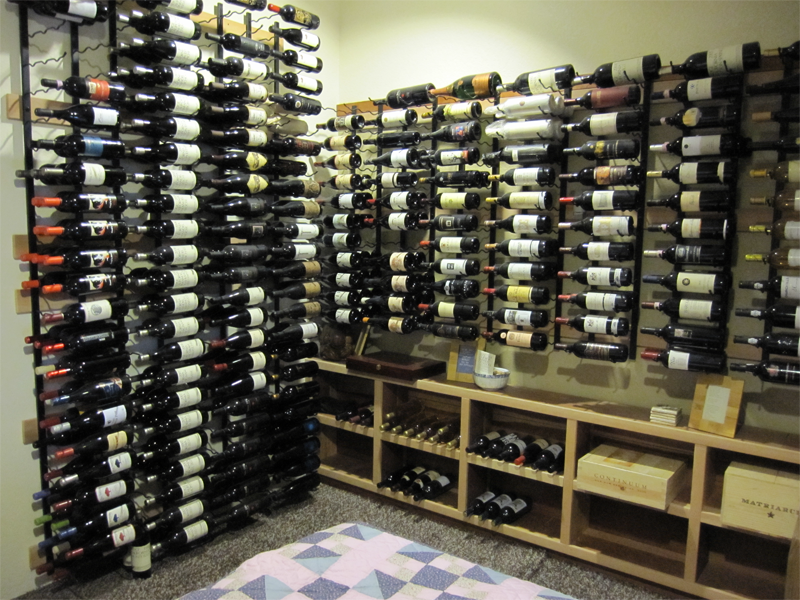
 
I’ve
had many hobbies, which I consider to represent on of life’s great
pleasures.  Among my favorites are: brewing beer, distilling hard
liquor, making wine, hydroponic gardening, construction / wood working
(I built the trading room / tiki shack shown in the picture, below), skiing,
mountain climbing.  I even went through a brief quilting phase, which
I’ve been mocked for incessantly!
 
Leisa: I've enclosed a picture of your wine room.  Is that
one of your quilts on the floor?

Biff: The quilt shown is something we
purchased at a
charity auction.  Boulder Dental Aid holds an annual fund raiser that we
support.  The money keeps a practice for low-income children
functioning.

 

LeisaI'm quite fond of the FatBoy Slim Weapon of
Choice video that you introduced to the Slope.  With respect to
trading, what would you describe as your Weapon of Choice? Are you a
futures, ETF, single equities guy, or a Renaissance man?  Also, what
time frame (short, intermediate, or long term) time frame do you use?


Biff : With any new profession or serious endeavor it’s
important to initially expand your knowledge base and be open to a huge
spectrum of ideas and styles.  Many assorted professions (including my
field of orthodontics) follow this philosophy.  What ultimately happens
to any effective professional is they submerge the vast majority of what
they’ve learned and focus on a single, predictable technique that works
for them.  This often takes years of practice to achieve, and some
never quite arrive.  The most dangerous surgeons are those that never
settled on a coherent, reproducible style for any given procedure they
perform.  Having a patient on life support and splayed open is no time
for contemplation and second-guessing oneself (insert your own trading
analogy here…)

 
Following
this process I very effectively formed a tremendous cloud of trading
information which led to my “paralysis by analysis” phase.  This lasted
many years, and I’m still shedding needless “baggage”.  I eliminate
concepts and ideas that don’t suit my purposes in a very Darwinian way. 
Through my experience trading I’ve tried countless methods for various
lengths of time, but ultimately always returned to what suits my personality:
day-trading with futures.  I’m not altogether comfortable in what that
says about me, quite frankly!
 
My trading knowledge came from
persistent personal study, but my trading style is assembled largely
from what I learned here on the Slope from people like you, Market
Sniper, Giledain, ComicFX, Viscous, and many others.  The willingness of
our friendly community to share and help others out is quite
remarkable.

Leisa:  We know that with most of things that we
undertake in life, those that challenge us help us develop needed
skills.  However, those challenges also unearth some weaknesses.  Would
you be willing to share with Slopers your single greatest strength and
how you've developed that in addition to your single biggest weakness
and how you have compensated for that?

 
Biff:  Ironically my twin strengths
also periodically become my twin weaknesses.  They are, 1- my
obsessive-compulsive focus / stubbornness, and 2- my comfort level with
risk taking.
 
If
compelled, I can tackle a single subject or problem for 18 hours a day
and months / years on end.  I refuse to give up until the issue is
solved to my satisfaction.  Naturally this becomes a net liability at
times as well, since virtually every other aspect of my life falls
dramatically on my priority list.  Trading is unique because it's been
my major extra curricular passion since 2002, far longer than any other
obsession has retained such a lofty status.  My comfort with taking a
risk has been a huge benefit in my life in general. I've never minded
moving to a new city, opening a business, taking on debt, initiating a
trade, going to school for protracted periods with no income,
etc.  Occasionally this risk-taking backfires.  I’m ashamed to admit I
purchased my house in May 2007.  Talk about lousy timing!  My penchant
for risk taking has also caused some hardships in a few areas. Starting a
practice from scratch resulted in zero income for two years, and I blew
out my trading account as a noob in 2002.  Overall, however, one must
take a chance or remain stagnant in life.

Leisa: If you had only one minute to spend with an aspiring,
avocational trader, what would you want to say to that person
?
 
Biff:  Focus on defense.  This game
might appear easy, but it isn't.  You will come face to face with the
darkest aspects of your personality.  There are some basics that you
should follow until you become comfortable with your own trading
psychology and methods.  If you find yourself violating these, you
should seriously question whether you have the makeup for trading,
because you are heading for disaster.

  •  Have a reasonable
    stop for every position you place.  Allow your stops to be hit without
    flinching.
  •  Don't use excessive leverage, and don't attempt to
    hit home runs.
  •  You are a student, and you must be willing to
    spend the time to learn.
  •  Avoid “gurus.”  Have faith in
    yourself.
  •  Eliminate the risk in any trade early by taking
    partial profits and raising your stops.

 
Leisa:   You trading room looks very
inviting! Biff, thanks for taking the time to share a few things with
Slopers. There is a reason why I call you Bifferific!


About Buying Every Dip

By -

The mantra these days from sea to shining sea is the same: Buy Every Dip. That works well for a while. It worked great for years during the last decade. Take note of that last buying opportunity, marked in purple:

0326-buythedip 

It is shown again in purple below. My point is this: one day, the dip slips. Buying a dip is no guarantee of profits. You might get five dips, or ten, or fifty – – nobody knows. But when the dip fails, look out, because everyone will have been trained to do nothing but buy dips, and you're going to wind up with a population that has no idea what to do next.

0326-thelastdip 

Speaking of dips, I said something dippy yesterday I should clarify: I did a post about the sad state of affairs at very blog sites, including this one. I jokingly made a reference to molecool's temper, but since some readers might not misconstrue what I said, let me clarify – – – I've known molecool for a long time, and he's a good guy. We've met each other once, and he was perfectly friendly (in spite of the 'Evil' moniker). Sorry if what I said came out the wrong way.