
Slope of Hope Blog Posts
Slope initially began as a blog, so this is where most of the website’s content resides. Here we have tens of thousands of posts dating back over a decade. These are listed in reverse chronological order. Click on any category icon below to see posts tagged with that particular subject, or click on a word in the category cloud on the right side of the screen for more specific choices.



Constant Latin American Examination Continues
Juggling Angry Badgers (by Springheel Jack)
People often forget that officials lie as a matter of course, and that open government is, in consequence, always something of a joke. One of my favorite quotes is from a film or documentary about Watergate where an official was answering questions from a politician trying to establish who first suggested that there should be a cover-up. The official replied that 'no-one ever suggested that there might not be a cover-up', and I expect that was exactly right. Yesterday there were two stories coming out of Japan about the potential nuclear accident there. The official version was that everything was well under control, and the second was from outside experts saying that flooding reactors with seawater was a last ditch desperation measure that was most unlikely to succeed. No prizes this morning for guessing which assessment was correct.
That's worth remembering when we hear soothing statements from central bankers about the desirability of obviously reckless money printing and debt accumulation, or when they make statements about inflation remaining subdued against a backdrop of obviously accelerating price inflation. We should always remember the image of Comical Ali (Mohammed Saeed al-Sahaf), the hapless Iraqi Information Minister, making statements about the US forces being crushed in the late stages of the invasion of Iraq, with US tanks rolling into Baghdad clearly visible behind him as he spoke. All of these officials see managing expectations and soothing fears as their job, none of them seek to disseminate the truth. Comical Ali was perfectly representative of officials making statements to the press, and it has always been so. Doubtless one of Nero's officials was dismissing reports of Rome burning as scaremongering as Nero fiddled and Rome burned behind him. As a breed they would have to work hard on improving their reputation for honesty to compete with a four year old child in search of chocolate.
Looking at the markets this morning in the wake of reports that the stricken nuclear reactor in Japan is now releasing large amounts of radiation to atmosphere. I see that the Nikkei is down over 10% overnight, and there have also been heavy falls in other developed equity markets. Some nice technical lows are developing at support, but a friend of mine remarked this morning that he'd rather juggle angry badgers this morning than play the open, and I'm inclined to agree. It wouldn't take a lot to see a flash crash situation develop here and using stops looks particularly important today.
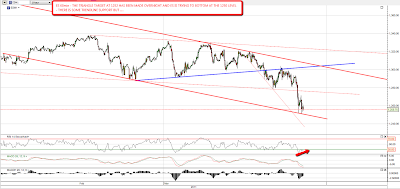
On ES the triangle target at 1252 was made overnight and ES is trying to make a short term low in the 1250 area. That might succeed short term, though I'm still expecting a test of the 1220-30 area before this correction ends:
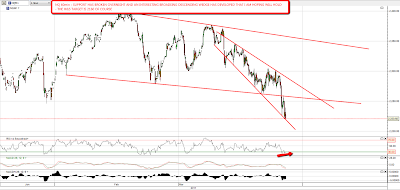
NQ fell through the 2250 support level, and retested it before going lower. That looks ominous and I'm hoping that a broadening wedge I've identified on the NQ chart holds today. The H&S target is 2160 of course, which would fit well with my ES target in the 1220-30 area, so I'm expecting more downside regardless of any bounce here:
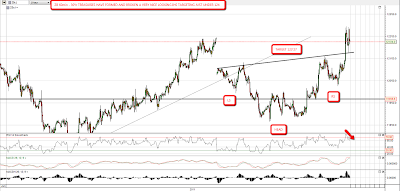
Looking at 30yr treasuries this morning I'm seeing strong signs that there will be more upside. Significant resistance has broken overnight and a very nice IHS has formed over the last few days with a target just under 124:
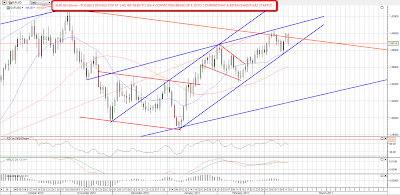
One big question this morning is whether the USD has enough credibility left to assume a traditional role as a flight to safety target with treasuries. Yen would normally be the third flight to safety trade of course, but probably not this time for obvious reasons. Looking at the EURUSD chart there is some sign that EURUSD may have made a double-top at 1.40, but we'll have to see a conviction break of 1.38 to confirm weakness:
The Nikkei is down over 20% in the last few days and is starting to look interesting. The current rising channel on this long term chart has broken overnight and I'm seeing strong trendline support in the 7700 area:
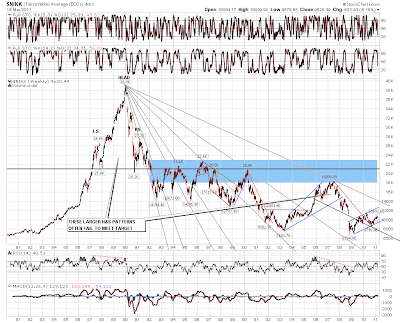
I posted a Vix 30 min chart the other day and the trendlines I drew on it have been holding beautifully. I'll be looking to see whether Vix breaks overhead resistance this morning and if it does I'll be expecting a move to the next resistance trendline in the 27 area:
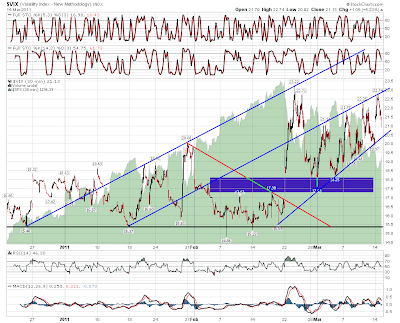
Overall I'm leaning towards a bounce here in the context of further falls later on, but it wouldn't take a lot to push this over the edge this morning so any longs should be cautious. The Ides of March are not always trouble free, as I'm sure Julius Caesar would agree.
Gorgeous Top for Latin America
2008 Financial Crisis European Sequel (by MacroStory.com)
The European Union is facing a similar set of events as those leading up to the 2008 US financial crisis. In 2007/08 the US economy was teetering on the brink of recession and the talk among many was that of a goldilocks soft landing. Economic data was still somewhat positive including job growth while equity markets were still holding up.
The housing market was beginning to show signs of exhaustion. Manufacturers were confronting rising input costs while consumers were paying more at the pump. The Federal Reserve introduced a new chairman who tried to calm markets with his infamous quote on March 28, 2007, "the impact on the broader economy and financial markets of the problems in the subprime markets seems likely to be contained."
Today Europe is faced with a subprime crisis of their own in terms of sovereign debt. Greece and Ireland have been bailed out and Portugal is only weeks from joining the esteemed list. Spain and Italy are a shock event away from joining as well. The EU also has their overconfident leadership as witnessed by the ECB Chief Economist Jurgen Stark on July 9, 2010 "The worst is over” (for Europe’s sovereign debt crisis).
According to a 2009 BIS report EU creditors had over 1.5 trillion euros in exposure to Spain, Ireland, Portugal and Greece. Of that amount, Germany and France accounted for 493 billion euros and 465 euros respectively. This is not a PIIGS "problem." In reality the debtors have equal or greater negotiating power over the creditors. TARP bailed out the insolvent banks at the expense of the taxpayer while the EFSF is bailing out the German and French banks at the expense of the PIIGS taxpayer. The similarities don't stop though.
The EU produced positive economic data in the latter part of 2010 while the euro was trading on average 1.28 (eur/usd). Over the past six months the euro has traded 6% higher at 1.36 which will reverse that positive trend. The impact of a rising euro on export driven economies like Germany which have been the only real source of growth in the EU will be negative. Rising input costs have been a worldwide phenomenon of late and the EU is not immune. Watch for shrinking corporate profits in the near future. The consumer is not immune either as record gas prices are now hitting the pumps across the EU. What will the shock event be though? In 2008 it was Lehman.
The US was able to delay the inevitable after Bear Stearns and so did the EU with Greece. Will Ireland be the Lehman failure that forces a massive hit to creditor and not taxpayer balance sheets? If so it will force a similar credit contraction among various credit facilities from commercial paper, interbank lending and more as witnessed in the US in 2008. In July 2008 oil was moving up very quickly until topping at 147 on July 14 (Bastille day, another similarity), just months before Lehman failed. Today as the global economy faces rising oil prices, the impact on the EU are far greater with Ireland and Italy alone importing over 20% of oil from Libya. With Libyan oil production all but shutdown, it is arguable that $147 oil has already arrived.
The US economy will not be immune to a sovereign debt crisis as the EU was not immune to the subprime crisis. It is not a "Greek debt problem" nor is it a "Middle East problem." The world is more connected today than ever before in history. We have seen this movie before and as we all know the sequel is usually far worse than the original.
Submitted by Macro Story. If you would like to read more, please visit - MacroStory.com
