Slope of Hope Blog Posts

Slope initially began as a blog, so this is where most of the website’s content resides. Here we have tens of thousands of posts dating back over a decade. These are listed in reverse chronological order. Click on any category icon below to see posts tagged with that particular subject, or click on a word in the category cloud on the right side of the screen for more specific choices.

More Thoughts on OWS (by Gary Tanashian)

By -

Chris Hedges has stirred up a mini epiphany in the blogosphere, especially considering the endless war-making that is employed in the name of corporate gain.  I am always against war, whether it is apparently 'justified' or not.  I hate war.  I supposed that sometimes it is necessary, but only to a tiny fraction of the scale to which it is systematically carried out.

A couple more articles for your consideration can be found here http://www.biiwii.com/analysis.htm.  The first, 'Going Apeshit' by James Howard Kunstler, shows the situation in cartoon-like fashion (a huge compliment, btw) as only Kunstler can.  He also shines a light on President Obama's superficial attempt to align himself with OWS for political gain.

(more…)

Inflation on Demand & Along the ‘Continuum’

By -

Global markets are in the midst of a predictable relief rally to the technical bear market that recently became actualized off of various topping patterns that were in force for most of 2011.  It is important to note that this is coming off of a similarly predictable whiff of a deflation scare, as US and European debt 'imbalances' (a polite way to put it) spooked the public out of asset markets and into US Treasury bonds, among other 'safe' havens.

Ben Bernanke, the current US Fed Chief, is a deflation scholar after all.  He is the man for the job and if he was hesitant to do his job, as was the case last spring amid the 'austerity movement' and a red-lined long term T bond yield, he can be less so now.  The 'bad cops' (Fisher, Plosser, Bullard, etc.) at the Fed have been marginalized for the time being with people like Robert Reich and Paul Krugman, along with their decidedly less financially austere views, are back in the public consciousness.

(more…)

Inviting the Vampire

By -

Nosferatu's Shadow

Dear SOH, I love October and Halloween, don't you?  😉

This article in no way pretends to be real, actionable analysis like that which appears in Notes From the Rabbit Hole (NFTRH) each week.  Rather, it is just a metaphorical riff on a big picture macro economic theme that is currently in play.

Setting the clock back to January of 2011, we find long term Treasury bond yields hitting a critical high along the 'continuum' and finally beginning to signal an end to the inflation hysteria – born of the previous Fed sponsored QE campaign – as illustrated on the blog in May.  At that time, it was noted that the Wizard (metaphor temporarily switched to 'Vampire' for today's article) was powerless to work his magic against an oncoming economic contraction in the face of inflamed inflation expectations (long term yields at a 'do or die' breakout point parameter) and a then rising 'austerity' movement in the US.

Well, you see in the picture above (source info) that times are much different, a mere 6 months later.  Indeed, austerity has been cast to the scrap heap as the usual macro-managers come out of the woodwork, one after another, and invite the Vampire back into our homes.  You know the legend is that the Vampire must be invited in, don't you?  There is nothing like decelerating global macro-economic fundamentals and caving asset markets when it comes to inviting the Vampire to do his work.

Why are we using the Vampire as the metaphor for the US Fed (and I might add, its counterparts the developed world over)?  Because they are now being called upon… invited to provide more policy – in the name of asset price inflation – that is ultimately destructive to would-be normal, healthy economies that thrive on productivity and investment of capital toward these things of productivity and value.

In short, more inflationary policy creates more macro debt burden, provides potential asset price inflation and a growing overhang from which many economies will fail to recover (insert here the macro subplot in Greece and the PIIGS in general, which are just a tip of an awfully big iceberg) as inflationary policy sucks the life out of a real economy over time and cycles.

So we have come full cycle.  The updated chart of the 'continuum' is in a picture, an invitation.  The most recent red arrow indicated a time when the Vampire was reviled and politically scorned.

The 'continuum' AKA secular trend in 30 yr yields

Now we have a different atmosphere – expected by this writer and indicated by the chart above so many months ago – with deflation and systemic collapse at the forefront of the collective financial and economic mindset.  Austerity?  Please, give me a break.  The Vampire has already received his invitation, but having been scorned so soundly earlier this year, he sits back and lets the call become louder by the week.

The balance of current NFTRH analysis holds that he may await a final capitulation to be sure that the invitation is near unanimous.  

http://www.biiwii.blogspot.com
http://www.biiwii.com

Gold is Getting ‘Fixed’

By -

Dear SOH, hi, it has been a while.  It was no use writing on the blog of a 'gold hater' like Tim 😉 and puffing up my plumage as the barbarous relic soared toward $1900/oz.  It is much better to do so during some serious carnage and questioning of the 'play'.  A deflationary event that I expected in the summer of 2010 (until the primary indicator, a gently bottoming gold-silver ratio {GSR}, was blown up by QE2), is finally upon us, complete with an impulsively rising GSR, which has broken out of a strong resistance zone we had been watching.

(more…)

Hedging Against a Dollar Drop

By -

Chafing at the world's reserve currency

After the excitement of the U.S. debt ceiling negotiations going down to the wire, Russian Prime Minister Vladimir Putin offered these comments about the U.S. and its dollar:

They are living like parasites off the global economy and their monopoly of the dollar.

[…]

If over there (in America) there is a systemic malfunction, this will affect everyone," Putin told the young Russians. "Countries like Russia and China hold a significant part of their reserves in American securities … There should be other reserve currencies.

With Putin's sentiments in mind, let's look at a way to hedge against a further drop in the dollar

Hedging the dollar

The steps below show how to hedge the dollar by buying optimal puts on the PowerShares DB USD Index (UUP) as a proxy for it. First a quick reminder about what optimal puts mean in this context.

About optimal puts

Optimal puts are the ones that will give you the level of protection you want at the lowest possible cost. As University of Maine finance professor Dr. Robert Strong, CFA has noted, picking the most economical puts can be a complicated task. With Portfolio Armor (available on the web and as an Apple iOS app), you just enter the symbol of the stock or ETF you're looking to hedge, the number of shares you own, and the maximum decline you're willing to risk (your threshold). Then the app uses an algorithm developed by a finance Ph.D to sort through and analyze all of the available puts for your position, scanning for the optimal ones.

A step by step example

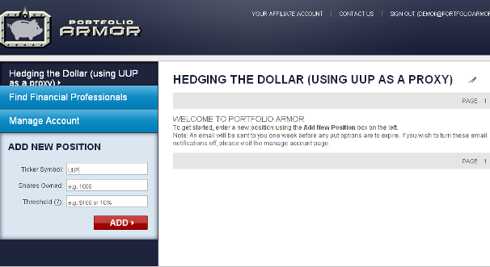
Step 1: Enter a ticker symbol

In this case, we're using UUP as a proxy for the dollar we've entered UUP in the Ticker Symbol field below.
Step 2: Enter a number of shares

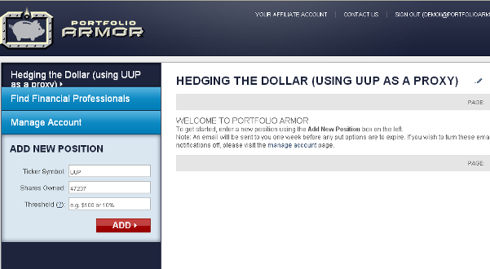
For the purposes of this example, let's assume an investor has a $1 million portfolio, all in dollar-denominated assets.  So, since we're using UUP as a proxy, the number of shares we'll enter will be $1,000,000 / the most recent share price of UUP ($21.17, as of after hours Monday) = 47,236.7. We've rounded that up to 47,237 and entered that number in the "Shares Owned" field in the screen cap below.
Step 3: Enter a decline threshold

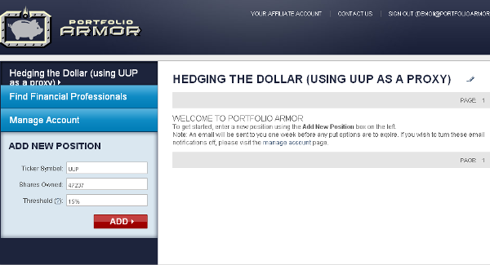
You can enter any percentage you like for a threshold when using Portfolio Armor (the higher the percentage though, the greater the chance you will find optimal puts for your position). I've entered 15% in the "Threshold" field below.
Step 4: Click the red button

A moment after clicking the red button, you'd see the screen cap below, which shows the optimal put option contracts to buy to hedge against a >15% drop in UUP between now and March 16, 2012. The cost of this protection on a $1 million position would be $6,608, or about 0.66% of the position value.1, 2
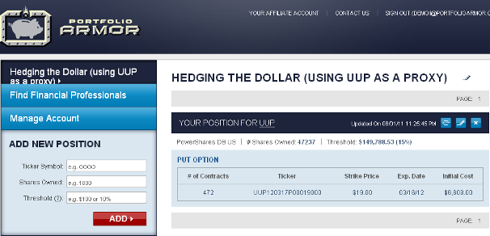
1Note that, in this case, Portfolio Armor rounded down the number of shares of UUP we entered to the nearest hundred (since one put option contract represents the right to sell one hundred shares of the underlying security), and then presented us with 472 of the put option contracts that would slightly over-hedge the 47,200 shares of UUP they cover, so that the total value of our 47,237 shares of UUP would be protected against a greater-than-15% decline.

2To be conservative, Portfolio Armor quoted that cost based on the ask price of the optimal puts. In practice, an investor can often purchase puts for a lower price, i.e., some price between the bid and the ask.