

Slope of Hope Blog Posts

Slope initially began as a blog, so this is where most of the website’s content resides. Here we have tens of thousands of posts dating back over a decade. These are listed in reverse chronological order. Click on any category icon below to see posts tagged with that particular subject, or click on a word in the category cloud on the right side of the screen for more specific choices.

Hedging Against a Dollar Drop

By -

Chafing at the world's reserve currency

After the excitement of the U.S. debt ceiling negotiations going down to the wire, Russian Prime Minister Vladimir Putin offered these comments about the U.S. and its dollar:

They are living like parasites off the global economy and their monopoly of the dollar.

[…]

If over there (in America) there is a systemic malfunction, this will affect everyone," Putin told the young Russians. "Countries like Russia and China hold a significant part of their reserves in American securities … There should be other reserve currencies.

With Putin's sentiments in mind, let's look at a way to hedge against a further drop in the dollar

Hedging the dollar

The steps below show how to hedge the dollar by buying optimal puts on the PowerShares DB USD Index (UUP) as a proxy for it. First a quick reminder about what optimal puts mean in this context.

About optimal puts

Optimal puts are the ones that will give you the level of protection you want at the lowest possible cost. As University of Maine finance professor Dr. Robert Strong, CFA has noted, picking the most economical puts can be a complicated task. With Portfolio Armor (available on the web and as an Apple iOS app), you just enter the symbol of the stock or ETF you're looking to hedge, the number of shares you own, and the maximum decline you're willing to risk (your threshold). Then the app uses an algorithm developed by a finance Ph.D to sort through and analyze all of the available puts for your position, scanning for the optimal ones.

A step by step example

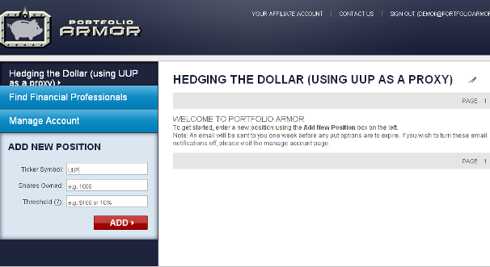
Step 1: Enter a ticker symbol

In this case, we're using UUP as a proxy for the dollar we've entered UUP in the Ticker Symbol field below.
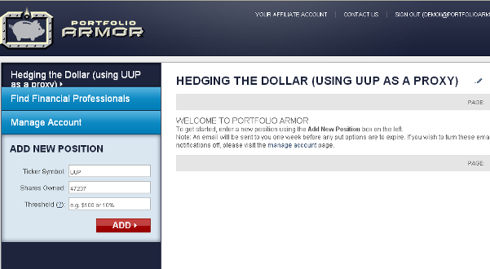
Step 2: Enter a number of shares

For the purposes of this example, let's assume an investor has a $1 million portfolio, all in dollar-denominated assets.  So, since we're using UUP as a proxy, the number of shares we'll enter will be $1,000,000 / the most recent share price of UUP ($21.17, as of after hours Monday) = 47,236.7. We've rounded that up to 47,237 and entered that number in the "Shares Owned" field in the screen cap below.
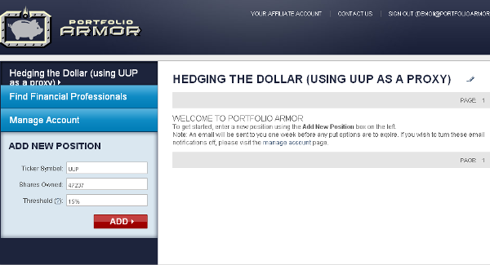
Step 3: Enter a decline threshold

You can enter any percentage you like for a threshold when using Portfolio Armor (the higher the percentage though, the greater the chance you will find optimal puts for your position). I've entered 15% in the "Threshold" field below.
Step 4: Click the red button

A moment after clicking the red button, you'd see the screen cap below, which shows the optimal put option contracts to buy to hedge against a >15% drop in UUP between now and March 16, 2012. The cost of this protection on a $1 million position would be $6,608, or about 0.66% of the position value.1, 2
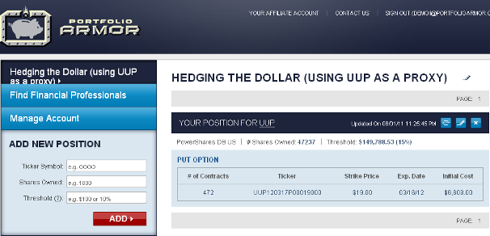
1Note that, in this case, Portfolio Armor rounded down the number of shares of UUP we entered to the nearest hundred (since one put option contract represents the right to sell one hundred shares of the underlying security), and then presented us with 472 of the put option contracts that would slightly over-hedge the 47,200 shares of UUP they cover, so that the total value of our 47,237 shares of UUP would be protected against a greater-than-15% decline.

2To be conservative, Portfolio Armor quoted that cost based on the ask price of the optimal puts. In practice, an investor can often purchase puts for a lower price, i.e., some price between the bid and the ask.

Costs of Hedging Treasury Bond Exposure Still Low, but Rising

By -

The chances of a debt ceiling deal

The Intrade prediction market enables participants to bet on whether Congress will approve an increase in the U.S. debt ceiling to $15.1 trillion on or before three dates: July 31st, August 31st, and September 30th. As of Tuesday evening, these were the chances of debt ceiling deals by those respective dates:

  • July 31st: 16.2% chance of a deal raising the debt ceiling to $15.1 trillion
  • August 31st: 75% chance of raising the debt ceiling by that much
  • September 30th: an 88.9% chance of raising the debt ceiling by that much

Unfortunately, Intrade doesn't offer a market for betting on whether a debt ceiling deal will be reached by August 2nd, the putative deadline.

Breaching the debt ceiling need not lead to an imminent default

If Congress can't come to a deal raising the debt ceiling in time, the U.S. government will not be able to borrow to pay all of its obligations, but that doesn't mean this will necessarily lead to an imminent default. The government could instead prioritize payments so that holders of Treasury securities get their interest payments as scheduled, while withholding payment from other parties (e.g., by furloughing some Federal workers, or by delaying some transfer payments).

Nevertheless, a failure of Congress to reach agreement on raising the debt ceiling would be inauspicious for holders of Treasury bonds. Another point to consider is that, even if a debt ceiling deal is reached, U.S. debt may still be downgraded at some point, which could lead to forced selling by funds which are required to own only AAA-rated bonds.

Hedging against a failure to raise the debt ceiling

In a post elsewhere earlier this month ("Helping House Majority Leader Hedge His Treasuries Exposure"), we noted reports that the House Majority Leader held "up to $15,000 in shares of the 2x levered ProShares Trust Ultrashort 20+ Year Treasury ETF (TBT)", an amount, we suggested, was probably too low to provide much of a hedge for his exposure to Treasuries.

A more precise way to hedge

As we mentioned in a previous post, precision is one of the advantages of using optimal puts, rather than inverse ETFs, to hedge:

  • Precision. Say you own 824 shares of Exxon Mobil, and you'd like to know how to hedge that position against a greater-than-17% loss. Using Portfolio Armor (available as a web app and as an Apple iOS app), you could simply enter "XOM" in the symbol field, "824" in the number of shares field, and "17%" in the threshold field, and then Portfolio Armor would use its algorithm to scan for the optimal puts to give you that level of protection at the lowest cost.1

The example above mentions a stock, but as we noted in that post earlier this month, Rep. Cantor could find optimal puts on the U.S. Treasury bond-tracking ETF, iShares Barclays 20+ Year Treasury Bond (TLT), as a proxy for his exposure to Treasury bonds, in the same way.

Hedging costs as of Friday's close

The table below shows the costs, as of last Friday's close, of hedging against greater-than-15% and -20% declines, respectively, in TLT until January 20th, 2012.

Symbol

Name

Decline Threshold

Cost as % of Position
TLT iShares Barclays 20+ Year Treasury Bond 15% 1.22%*

TLT

iShares Barclays 20+ Year Treasury Bond

20%

0.66%*

Hedging costs as of Tuesday's close

The table below shows the costs, as of Tuesday's close, of hedging greater-than-15% and -20% declines, respectively, in TLT until January 20th, 2012. Note that the costs are still relatively low, but have increased since Friday.

Symbol

Name

Decline Threshold

Cost as % of Position
TLT iShares Barclays 20+ Year Treasury Bond 15% 1.48%*

TLT

iShares Barclays 20+ Year Treasury Bond

20%

0.77%*

*Based on optimal puts expiring in January, 2012.

1In that case, Portfolio Armor would round down the number of shares you entered to the nearest hundred (since one put option contract represents the right to sell one hundred shares of the underlying security), and then present you with eight of the put option contracts that would slightly over-hedge the 800 shares they cover, so that the total value of your 824 shares would be protected against a greater-than-17% loss.

Waste and Fraud

By -

As I suspect many of you did, I listened to the Obama speech tonight, as well as Boehner's response.

Since I was listening to George Carlin earlier today, it was exquisitely painful to hear both of these men speak, particularly since – as George predicted – each of them uttered the required-by-law phrase "God bless you, and God bless America" at the end of their spiels. 

I'm not going to go all Karl D. on you, but I do want to latch on to one thing which really ticked me off: Obama's declaration that, among other things, we could "slash waste and fraud in Medicare and Social Security" to save hundreds of billions of dollars.

I have heard the argument about "slashing waste and fraud" for as long as I can remember – – – decades. I will ask you, dear reader, as calmly as I can, this question: if there are known areas of waste and fraud that can be attacked in order to save many billions of dollars, why in the name of my personal Lord and savior Jesus H. Christ aren't we doing it right now? Why wait?

Oh, wait. I know why! Because it's just a load of political bullshit! That's right!

Seriously, though. Seriously. What if you and I were in business together, and we held a weekly meeting, you and me. And I told you, week after week, that one thing we could really do to help the business was to stop leaving a big pile of cash in front of our shop, since it kept getting stolen all the time.

How many meetings would you wait until you slapped me across the face and told me to stop doing that? Four meetings? Three? I imagine "One" would probably be the right answer. And you'd probably swing pretty hard.

I realize that both of these men who spoke tonight had to try to speak with a cadence and content that could be vaguely grasped by the average American. All the same, the above really, really pisses me off, because it's so grotesquely fake.

Love,

– Tim

0725-waste