Slope of Hope Blog Posts

Slope initially began as a blog, so this is where most of the website’s content resides. Here we have tens of thousands of posts dating back over a decade. These are listed in reverse chronological order. Click on any category icon below to see posts tagged with that particular subject, or click on a word in the category cloud on the right side of the screen for more specific choices.

Hedging GLD, Before And After Its Recent Drop

By -

Gold Bugs Crushed

Hey fellow Slopers,

As Tim noted on Friday (“Kooks’ Last Stand”), the collapse in gold and its SPDR tracking ETF GLD has been shocking, particularly to those who figured QE Infinity would drive gold prices to new highs. Back in January, I posted a couple of GLD hedges. In this post, we’ll take a look at how one of them reacted as GLD dropped on Friday. Then we’ll look at a way to hedge GLD now. (more…)

Hedging The Dow At Its All-Time High

By -

The Dow Hits An All-Time High

With the Dow Jones Industrial Average hitting all-time highs recently (albeit, not in inflation-adjusted dollars), in this post, we'll look at the current costs of hedging the Dow component stocks against greater-than-20% drops. We'll also look at the optimal puts1 to hedge a position in the Dow-tracking ETF DIA against the same decline threshold.

Two Reasons To Track Hedging Costs

The first reason to pay attention to hedging costs is if you're considering hedging. But another reason is that we've seen some examples of stocks with high optimal hedging costs underperform those with lower optimal hedging costs. It will be interesting to revisit these Dow component stocks later this year and see if that pattern holds up.

Hedging Costs Of The Dow Components And DIA

The table below shows the costs, as of Tuesday's close, of hedging
each Dow component, and the Dow-tracking ETF (DIA), against
greater-than-20% declines over the next several months, using optimal puts.

Symbol

Name

Cost of Protection (as % of Position value)

AA

Alcoa Inc. Common Stock

3.11%***

AXP

American Express

1.72%***

BA

Boeing

1.30%*

BAC

Bank of America

3.20%*

CAT

Caterpillar

1.75%*

CSCO

Cisco Systems

2.50%*

CVX

Chevron

1.37%**

DD

E.I. du Pont de Nemours

1.71%***

DIS

Walt Disney

2.55%***

GE

General Electric

1.61%**

HD

Home Depot

1.04%*

HPQ

Hewlett-Packard

3.19%*

IBM

International Business Machines

1.12%***

INTC

Intel

2.14%***

JNJ

Johnson & Johnson

0.68%***

JPM

JP Morgan Chase

1.92%**

KO

Coca-Cola

0.65%*

MCD

McDonald's

0.65%**

MMM

3M

1.14%***

MRK

Merck

1.64%***

MSFT

Microsoft

1.83%***

PFE

Pfizer

1.03%**

PG

Procter & Gamble

1.17%***

T

AT&T

1.21%***

TRV

Travelers

1.80%***

UNH United HealthGroup, Inc. 2.10%**

UTX

United Technologies

1.17%*

VZ

Verizon Communications

1.11%***

WMT

Wal-Mart Stores

0.66%**

XOM

Exxon Mobil

1.25%***

DIA

SPDR Dow Jones Industrial Average ETF

0.64%**

*Based on optimal puts expiring in August

**Based on optimal puts expiring in September

***Based on optimal puts expiring in October.

The Optimal Puts To Hedge DIA

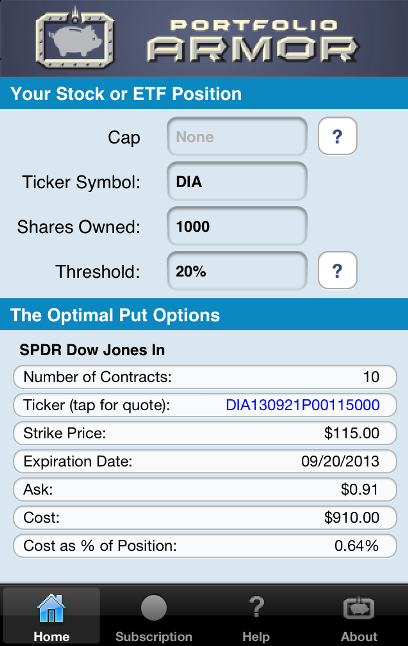
These were the optimal puts to hedge 1000 shares of DIA against a greater-than-20% drop as of Tuesday's close.
1Optimal puts are the ones that will give you the level of protection you want at the lowest possible cost. Portfolio Armor
uses an algorithm developed by a finance Ph.D to sort through and
analyze all of the available puts for your stocks and ETFs, scanning for
the optimal ones. The screen capture below from the latest build of the soon-to-come 2.0 version of the
Portfolio Armor iOS app.

Cushioning A Cliff Dive

By -

Not Reading Slope Can Be Expensive

Back on Tuesday, February 12th, our host Tim noted natural resources stocks were weakening and suggested shorting Cliffs Natural Resources (CLF).

The next day, Cliffs dived 20% after announcing a cut in its dividend after the close on Tuesday.

From A Mess To The Masses

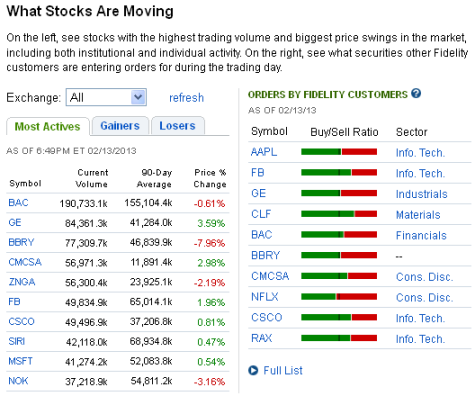
The old Odd Lot Theory was based on a simple premise: the average, small investor (those who couldn't afford round lots of shares) was usually wrong. Guess which stock Fidelity customers were buying with both hands as it dropped 20% on February 13th?

(more…)

Hedging GLD As The Herd Shakes Out

By -

Shaking Out The Herd

In a Slope post on Tuesday ("30.2 Yield Curve And Gold"), Gary Tanashian noted that, "over the last 1.5+ years gold has shaken out the herd". Our host Tim, not one to follow herds, reminded us on Tuesday that he's currently long gold via GLD ("Target on GLD Long Approaching"); nevertheless, according to Reuters, more GLD herd members did get shaken out last month, with the gold ETF seeing a billion dollars in outflows in January. In this post, we'll look at a couple of updated hedges for GLD. First, though, a note about Bernanke's testimony yesterday, and an interesting gold chart Bespoke Investment Group posted in response to it.


(more…)

Reining In The Risk Of A Triple-Leveraged ETF

By -

The Downside Of Leveraged ETFs

Leveraged ETFs can add some excitement to a
portfolio: bet right on underlying index, and you can earn double or
triple the returns of that index. The downside of leveraged ETFs,
though, is their potential downside. Consider one of the most
widely-traded leveraged ETFs, the Direxion Daily Gold Miners Bull 3X
Shares (NUGT): we're just about six weeks into 2013, and unhedged NUGT
longs who bought the ETF at the beginning of the year are already down
more than 29%, as of Tuesday's close (unhedged longs, that is, who didn't use stops. A quick search of Social Trade shows that the last Sloper who wrote about buying NUGT prudently used a stop order). 

Too Expensive To Hedge Against A >20% Drop With Optimal Puts

As
we noted in a recent post, hedging a security against a
greater-than-20%
drop can offer a reasonable compromise between limiting downside risk
and lowering the cost of hedging. Unsurprisingly for such a volatile ETF
(as of Tuesday, the 52-week high
and low prices on NUGT were $26.69 and $7.62, respectively), its
puts are expensive. On Tuesday, NUGT was too expensive to hedge against
a greater-than-20% drop using optimal puts*. That's because the cost of
hedging it against a greater-than-20% drop over the next several months
was itself greater than 20% of position value.

(more…)